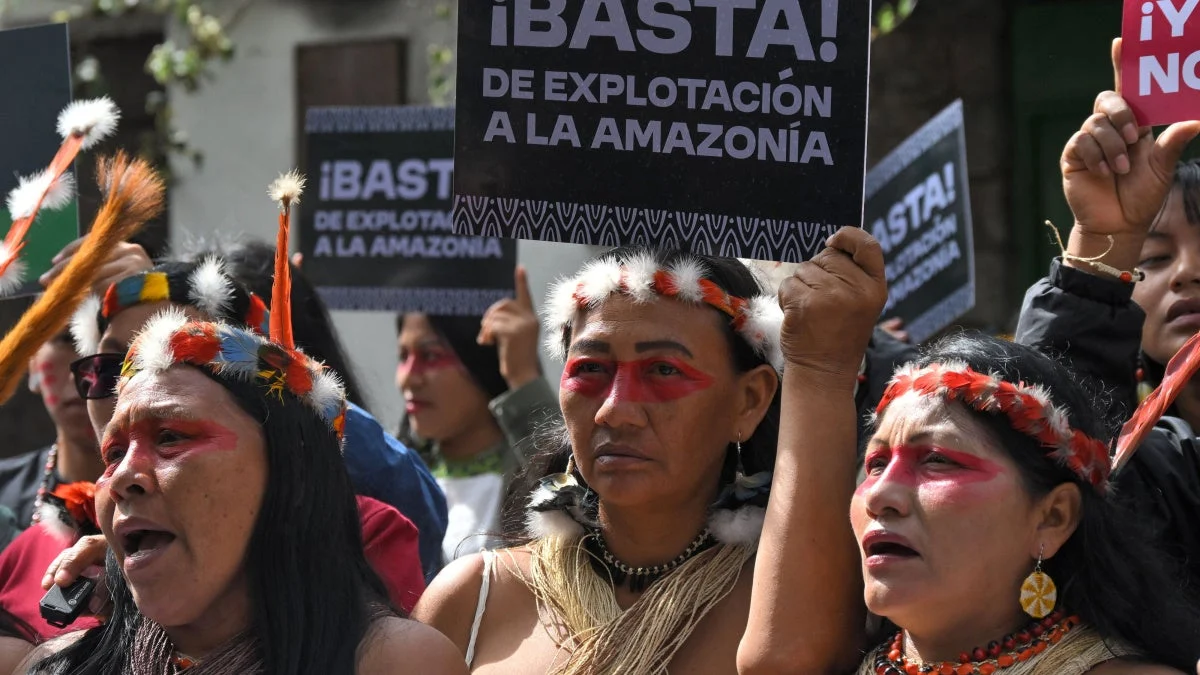
Ecuador Fails to Comply with Inter-American Court Ruling to Protect Isolated Indigenous Peoples in Yasuní National Park
Ecuador is currently failing to adhere to critical mandates issued by the Inter-American Court of Human Rights (IACHR) aimed at protecting the Tagaeri and Taromenane Indigenous peoples, Human Rights Watch (HRW) reported today. These groups, who live in voluntary isolation within the biodiverse Yasuní National Park, face an existential threat due to ongoing oil extraction activities in Block 43, also known as the ITT (Ishpingo, Tambococha, and Tiputini) fields. Despite a March 14, 2025, court order demanding an immediate cessation of operations and a 2023 national referendum in which the Ecuadorian public voted to keep the oil in the ground, the government has continued production, prioritizing economic output over international legal obligations and Indigenous rights.
The situation underscores a deepening tension between the Ecuadorian state’s reliance on fossil fuel revenues and its commitment to human rights and environmental conservation. According to HRW, the government’s failure to implement protective measures, coupled with a lack of transparency regarding environmental conditions, has placed the last peoples living in isolation in Ecuador at extreme risk of forced contact, disease, and resource-driven conflict.
The Legal Mandate and the 2023 Referendum
The legal battle over Block 43 reached a historic turning point on August 20, 2023, when a national referendum saw a majority of Ecuadorians vote to halt oil extraction in the Yasuní National Park indefinitely. The Constitutional Court of Ecuador subsequently ordered the government to implement this result by August 2024, requiring the progressive dismantling of infrastructure and the restoration of the affected environment.
However, as of early 2026, the government of President Daniel Noboa has largely ignored these deadlines. The Inter-American Court of Human Rights reinforced the domestic ruling in March 2025, finalized in September 2024, finding that Ecuador had violated the rights of the Tagaeri and Taromenane. The court specifically cited the authorization of oil operations surrounding forbidden zones without adequate risk assessments. It ordered the state to adopt all necessary legislative and administrative measures to ensure the referendum’s implementation and the prohibition of oil exploitation in Block 43.
José Rodríguez Orúe, a Kenneth Roth practitioner-in-residence at Human Rights Watch, stated that the refusal to close Block 43 "erodes [Ecuador’s] commitments to the regional human rights system" and "undermines the democratically expressed will of its people."
Continued Extraction and Economic Justifications
Data from the state-owned oil company, Petroecuador, reveals that production in Block 43 has remained remarkably stable throughout 2025, despite the court orders. Monthly extraction averaged approximately 1.2 million barrels, with daily output hovering around 44,000 barrels. This represents roughly 9.4 percent of Ecuador’s total crude production.
The Noboa administration has defended the continued operations by citing the potential for severe economic damage. Government officials have argued that an immediate shutdown would devastate the national budget, as oil remains a pillar of the economy, contributing approximately 12 percent of the nation’s Gross Domestic Product (GDP). Consequently, the administration has proposed postponing the total closure of the fields until 2029, a timeline that environmental defenders and Indigenous leaders argue is a direct violation of the law.
In February 2026, Human Rights Watch sought comment from Petroecuador regarding the continued operations, but the state company has yet to provide a formal response.
A Chronology of Conflict and Protection Efforts
To understand the current crisis, it is necessary to examine the long-standing history of the Yasuní region:
- 1950s: The Waorani people make their first contact with the outside world. Some clans, including the Tagaeri and Taromenane, choose to retreat deeper into the forest to maintain voluntary isolation.
- 1979: Yasuní National Park is established by law.
- 1989: UNESCO designates the park as a Biosphere Reserve due to its unparalleled biodiversity.
- 1999: Ecuador establishes the "Tagaeri Taromenane Intangible Zone" (ZITT), a core protected area where extractive activities are strictly forbidden.
- 2013: The National Assembly declares oil exploitation in Blocks 31 and 43 to be of "national interest," overriding previous protections and allowing drilling to begin.
- 2023: A national referendum results in a mandate to stop all oil activity in Block 43.
- March 2025: The IACHR officially communicates its ruling, ordering the immediate protection of isolated groups and the closure of Block 43.
- September 2025: The deadline passes for the government to establish a court-ordered Technical Evaluation Commission.
Environmental and Health Impacts on Local Communities
The impact of oil operations is not limited to the isolated Tagaeri and Taromenane; it is actively felt by the neighboring Waorani and Kichwa communities. Between November and December 2025, HRW interviewed 13 leaders and members of the Waorani people, who shared accounts of deteriorating health and environmental degradation.
Community members reported that the Salado River and other vital waterways have become polluted, leading to skin rashes, blisters, and gastrointestinal illnesses, particularly among children and the elderly. Isabel Baihua, leader of the Waorani Women’s Association of Orellana, noted that animals are dying and the water is no longer safe for bathing or drinking.
While Petroecuador’s 2024 feasibility report claimed that "no spills have been recorded" in Block 43—reclassifying 29 documented incidents as "operational events" with no impact—the Ministry of Environment, Water and Ecological Transition reported a diesel spill in June 2024 that reached the Salado River. This contradiction highlights a significant gap in official transparency.
Furthermore, satellite imagery and remote sensing analyzed by HRW in 2025 detected intermittent gas flaring at the Tiputini Processing Center. Scientific research indicates that such flaring can lead to acid rain, which damages staple crops like cassava and plantains, the primary food sources for local Indigenous populations.
Failure to Monitor and the "No-Go Zone"
A central component of the IACHR ruling was the requirement for Ecuador to establish a Technical Evaluation Commission by September 2025. This commission was intended to map the movements of isolated peoples and determine if the "Intangible Zone" needs expansion to reflect the groups’ semi-nomadic hunting and mobility patterns.
The government has failed to establish this commission. Juan Bay, president of the Waorani Nationality of Ecuador (NAWE), expressed frustration over the lack of dialogue, stating that the government lacks the will to engage with Indigenous representatives on the closure and reparation process.
The IACHR also flagged concerns regarding the "precautionary principle." Under this legal standard, the state is required to take preventive measures to avoid irreversible harm even in the absence of absolute scientific certainty. The court concluded that the proximity of Block 43 to the buffer zone of the Intangible Zone creates an unacceptable risk of forced contact and resource competition.
Institutional Weakening and Lack of Transparency
Ecuador’s ability to fulfill its human rights obligations has been further complicated by recent institutional changes. President Noboa downgraded the Ministry of Environment, Water and Ecological Transition into a vice-ministry under a newly formed Ministry of Environment and Energy. Similarly, the Ministry of Women and Human Rights was downgraded to a vice-ministry.
These changes have coincided with a significant decrease in public access to information. By law, the Ministry of Environment must submit monitoring reports to the National Assembly every six months. However, the ministry has not disclosed the two most recent reports due in 2025. National Assembly member Mariana Yumbay noted that the information provided is often incomplete and delayed, hindering oversight efforts.
The Citizen Oversight Committee, established to monitor the 2023 referendum’s implementation, reported in late 2025 that state institutions repeatedly refused to provide data on environmental impacts. Their final report concluded that the government’s actions were "merely formal" and lacked any concrete plan for redress or protection.
Broader Implications and the Path Forward
The situation in Yasuní serves as a global litmus test for the enforcement of international human rights rulings against the interests of the fossil fuel industry. If Ecuador continues to ignore the IACHR and its own domestic referendum, it risks setting a precedent that economic expediency can override both the rule of law and the survival of vulnerable Indigenous populations.
Environmental defenders filed a compliance case against the government in November 2025, seeking to force the closure of Block 43. For the Tagaeri and Taromenane, the stakes are nothing less than total. As semi-nomadic peoples, their survival depends on the integrity of their territory, the purity of their water, and the absence of outside interference.
Human Rights Watch and various Indigenous organizations are calling on the Ecuadorian government to:
- Immediately suspend all oil extraction in Block 43 and begin the decommissioning of infrastructure.
- Establish the court-ordered Technical Evaluation Commission with full participation from the Waorani people.
- Restore the institutional independence and funding of environmental and human rights ministries.
- Provide transparent, real-time access to environmental monitoring data and health impact assessments for all affected communities.
As the March 2026 deadline for improving protective measures approaches, the international community continues to watch whether Ecuador will honor its democratic and human rights commitments or continue its current path of non-compliance.

Related Posts

Human Rights Watch Calls for Investigation into Death of Detainee Following Removal from Najaf Hospital by Iraqi Drug Police
Human Rights Watch Urges UN Security Council to Extend Lebanon Peacekeeping Mission Amid Escalating Conflict and Humanitarian Crisis