Israeli Settler Violence and West Bank Land Seizures Accelerate Under the Cover of Regional Conflict
The convergence of regional instability and domestic military operations has created a strategic vacuum in the West Bank, where armed Israeli settlers are reportedly intensifying efforts to seize Palestinian land and accelerate the displacement of local communities. While the international community and the Israeli public remain focused on the immediate threats of missile and drone exchanges involving regional actors, human rights organizations warn that a "fog of war" is being utilized to facilitate a permanent restructuring of the occupied territories. This escalation is characterized by a significant rise in physical violence, the destruction of property, and the advancement of long-dormant settlement projects that threaten the geographic continuity of any future Palestinian state.
The Escalation of Violence and the Fog of War
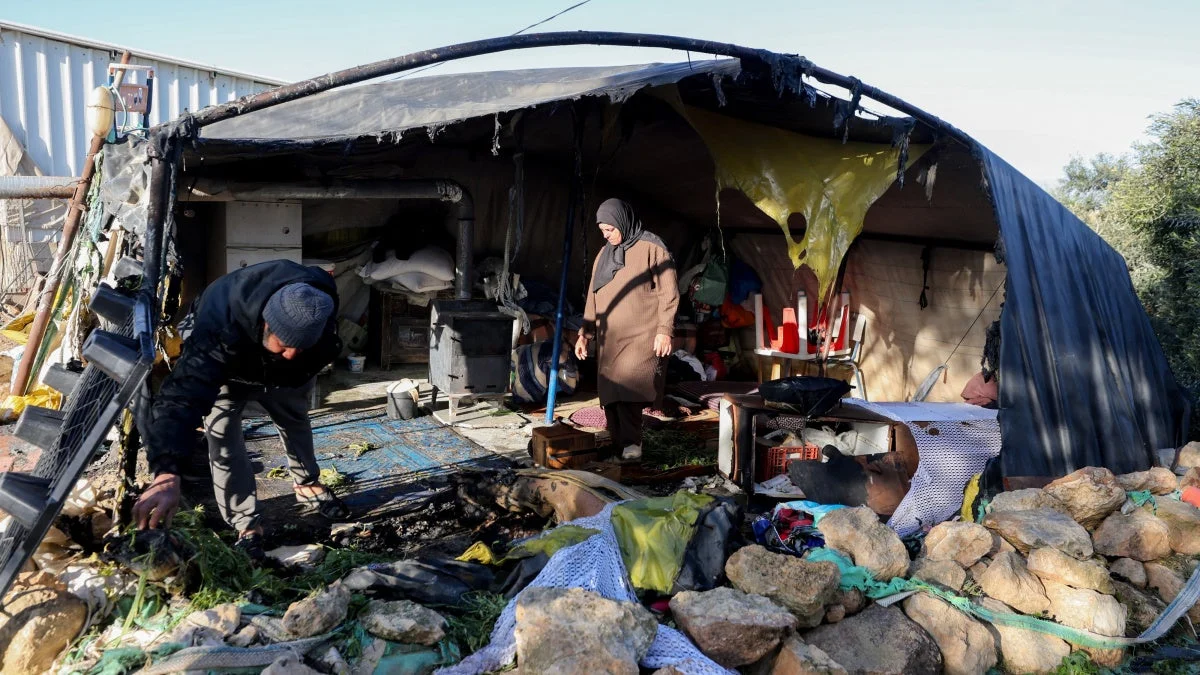
Since the intensification of regional hostilities, Palestinian communities across the West Bank have reported a sharp increase in coordinated attacks by armed settlers. These incidents are no longer isolated skirmishes but appear to be part of a systematic campaign to intimidate residents into abandoning their lands. Over the past eleven days alone, armed groups—including individuals wearing military uniforms—have been implicated in the deaths of five Palestinians. A sixth fatality was recorded after an individual suffered cardiac arrest following the inhalation of tear gas deployed by the Israeli army during a confrontation.
The nature of these attacks has become increasingly brazen. Reports from local monitors, such as Yesh Din and Masafer Yatta activists, document daily incursions where settlers fire live ammunition, set homes and vehicles ablaze, and assault families within their own residences. This surge in activity places 2026 on a trajectory to become the most violent year for Palestinians in the West Bank in recent history, potentially surpassing the record-breaking levels of violence seen in 2025. In that year, settler violence reached a two-decade high, with armed civilians responsible for the deaths of nine Palestinians and the displacement of numerous pastoralist communities.
A Chronology of Intensifying Pressures
The current crisis is the culmination of several years of escalating tension and policy shifts within the Israeli government. To understand the present situation, it is necessary to examine the timeline of events that led to this juncture:
- October 2023: Following the outbreak of major hostilities in Gaza, West Bank settlers began a concerted effort to restrict Palestinian movement, utilizing roadblocks and armed patrols to isolate villages.
- July 2024: The International Court of Justice (ICJ) issued a landmark advisory opinion, ruling that Israel’s 57-year (at the time) occupation of Palestinian territory was unlawful. The court characterized the administration of the West Bank as a system of apartheid and called for the immediate cessation of settlement expansion and the evacuation of all settlers.
- August 2025: Despite the ICJ ruling, the Israeli government formalized plans to move forward with the E1 settlement project. This project, situated between East Jerusalem and the Ma’ale Adumim settlement, had been frozen for years due to intense international pressure.
- December 2025: The Israeli Land Authority published a tender for 3,401 housing units in the E1 area, signaling a definitive move to ignore international "red lines."
- March 2026: Construction tenders are scheduled to be awarded to bidders on March 16, marking the beginning of a project that many analysts believe will render a contiguous Palestinian state impossible.
The E1 Project and the Bisection of the West Bank
The strategic significance of the E1 (East 1) settlement project cannot be overstated. For decades, the international community—including the United States and the European Union—has viewed the development of this 12-square-kilometer area as a terminal blow to the two-state solution.
If completed, the E1 project will create a continuous block of Israeli urban development from West Jerusalem to the Jordan Valley. Geographically, this would effectively sever the northern West Bank (cities like Nablus and Jenin) from the southern West Bank (Hebron and Bethlehem). Furthermore, it would completely encircle East Jerusalem, cutting it off from its Palestinian hinterland. This geographic bisection would transform the West Bank into two separate enclaves, making the administration of a unified Palestinian territory logistically and politically unfeasible.
Data on Impunity and Government Abetment
A critical factor driving the current wave of violence is the perceived and documented state of impunity for settler actions. Data released by the Israeli NGO Yesh Din at the end of 2025 highlights a staggering lack of legal accountability. Of the hundreds of settler violence cases documented by the organization since October 2023, only three percent resulted in convictions.
Critics argue that this lack of prosecution is not merely a failure of the judicial system but a deliberate policy of the state. The Ministry of National Security, headed by Itamar Ben-Gvir, has overseen the distribution of thousands of firearms to civilian "security squads" in settlements. Human rights groups argue that by arming these groups while simultaneously failing to enforce the law against them, the Israeli government is effectively outsourcing state violence to ideological actors.
The presence of settlers in military uniforms during attacks further blurs the line between official state action and civilian vigilantism. This "dual role" allows for a level of plausible deniability while ensuring that settler interests are protected by the full weight of the Israeli Defense Forces (IDF). When questioned about recent fatalities and arson attacks, the Israeli military typically states that the incidents are "under investigation," though these investigations rarely lead to indictments or public reports.
International Legal Standing and Apartheid Findings
The escalation in the West Bank occurs against the backdrop of a profound shift in the international legal landscape. The July 2024 ruling by the International Court of Justice was a watershed moment, as the world’s highest court concluded that Israel’s presence in the occupied territories constitutes an illegal annexation. The court’s findings on apartheid were based on the observation of a two-tiered legal system: one for Israeli settlers, who enjoy the protections of civil law, and another for Palestinians, who are subjected to restrictive military rule.
The ICJ’s mandate was clear: Israel is obligated to provide full reparations for the damage caused by its occupation, allow for the return of displaced persons, and dismantle the settlement enterprise. However, the current reality on the ground demonstrates a move in the opposite direction. Instead of evacuation, there is expansion; instead of reparations, there is further dispossession.
Official Responses and Global Implications
The international response to the current surge in violence has been characterized by a mix of rhetorical condemnation and limited targeted actions. Several Western nations, including the United States, United Kingdom, and France, have imposed individual sanctions on specific settlers known for extremist violence. However, human rights organizations argue that these measures are insufficient because they target individuals rather than the systemic structures—such as government funding and military protection—that enable the violence.
Human Rights Watch and other international bodies have called for more robust interventions, including:
- Targeted Sanctions: Moving beyond individual settlers to sanction government officials and entities involved in settlement expansion.
- Arms Embargoes: Suspending the transfer of weapons that are being diverted to civilian security squads in the West Bank.
- Trade Restrictions: Banning the import of goods produced in illegal settlements and suspending preferential trade agreements that do not distinguish between Israel’s sovereign borders and the occupied territories.
- Support for the ICC: Encouraging the International Criminal Court to execute arrest warrants for those implicated in war crimes and crimes against humanity in the West Bank.
Broader Impact and the Future of the Region
The ongoing dispossession of Palestinian communities has profound humanitarian and geopolitical consequences. Economically, the seizure of agricultural and grazing lands deprives thousands of families of their livelihoods, creating a cycle of poverty and dependence. Socially, the constant threat of violence and the destruction of infrastructure—such as solar panels, water tanks, and schools—leads to deep-seated psychological trauma and the fragmentation of community life.
From a geopolitical perspective, the "irreversible" nature of the E1 project and similar expansions suggest that the window for a negotiated settlement based on international law is rapidly closing. As the Israeli government continues to fund and embolden the settlement movement, the prospect of a long-term conflict becomes more certain.
The failure of the international community to move from condemnation to enforcement is seen by many observers as a green light for the continuation of these policies. Without a significant shift in the cost-benefit analysis for the Israeli government, the "fog of war" will likely continue to serve as a veil for the fundamental transformation of the West Bank, with grave consequences for the future of both Palestinians and the broader stability of the Middle East. As the tenders for E1 are awarded this March, the reality of a bisected territory moves from a theoretical threat to a concrete, physical barrier to peace.

Related Posts
Human Rights Watch Calls for Investigation into Death of Detainee Following Removal from Najaf Hospital by Iraqi Drug Police
Human Rights Watch Urges UN Security Council to Extend Lebanon Peacekeeping Mission Amid Escalating Conflict and Humanitarian Crisis