President Trump Vows U.S. Navy Will ‘Clean Out’ Strait of Hormuz Amid Stalled Nuclear Negotiations with Iran
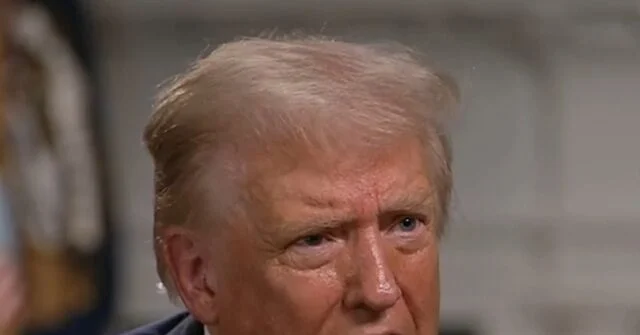
During a broadcast of Fox News Channel’s “Sunday Morning Futures,” then-President Donald Trump asserted that the U.S. Navy would “clean out” the Strait of Hormuz, a critical global maritime chokepoint, as he discussed the ongoing, contentious negotiations surrounding Iran’s nuclear program. Speaking with host Maria Bartiromo, the President underscored his administration’s unwavering stance against Iran developing nuclear weapons, characterizing it as the paramount issue in diplomatic discussions.
The President’s Assertions and the Negotiation Backdrop
President Trump’s remarks came in response to Bartiromo’s inquiry about the situation in the Strait of Hormuz, where tensions with Iran had frequently flared. "Well, we’re going to be blockading. It’ll take a little while, but it’ll be effective pretty soon," Trump stated, adding, "It won’t take long to clean it out. So we’re going to clean out the strait, and they’ll be able to use the strait and not too long a distance." This forceful declaration suggested a readiness to employ military might to ensure freedom of navigation through the vital waterway, which Iran has repeatedly threatened to disrupt.
The President also alluded to intense, protracted negotiations with Iranian representatives. He mentioned meetings lasting "21 hours" with "very good representatives" including individuals he referred to as "JD and Steve and Jared," likely referencing senior advisors within his administration involved in high-level diplomatic efforts, such as John Bolton (then National Security Advisor), Steve Mnuchin (then Treasury Secretary), or Jared Kushner (then Senior Advisor to the President). Trump revealed that while progress had been made on many points, the core sticking point remained Iran’s nuclear ambitions. "We didn’t get there on the important issue. They want to have nuclear weapons, they’re not going to have nuclear weapons," Trump emphasized, reiterating a long-held personal conviction. "I’ve been saying that for 30 years. I would never allow that to happen before I was in politics, and that country will not have nuclear weapons."
The Strategic Significance of the Strait of Hormuz
The Strait of Hormuz is arguably the world’s most crucial oil transit chokepoint. Located between Oman and Iran, it connects the Persian Gulf with the Arabian Sea and the broader Indian Ocean. Approximately one-fifth of the world’s total oil consumption, and roughly one-third of the world’s liquefied natural gas (LNG), passes through this narrow waterway daily. This translates to an estimated 17-20 million barrels of crude oil and petroleum products per day, making it indispensable for global energy security. Major oil producers like Saudi Arabia, Iran, Iraq, Kuwait, Qatar, and the United Arab Emirates rely heavily on the Strait for their exports.
Any significant disruption to traffic in the Strait of Hormuz could trigger a catastrophic shock to global energy markets, leading to soaring oil prices, supply chain disruptions, and widespread economic instability. The international community, therefore, maintains a vested interest in ensuring its free and safe passage.
A History of Tensions: U.S.-Iran Relations and the Gulf
Tensions between the United States and Iran have been a defining feature of Middle Eastern geopolitics since the 1979 Iranian Revolution. During the Trump administration, these tensions escalated significantly following the U.S. withdrawal from the Joint Comprehensive Plan of Action (JCPOA), commonly known as the Iran nuclear deal, in May 2018. The U.S. then reimposed and expanded a robust "maximum pressure" campaign of sanctions aimed at crippling Iran’s economy and compelling it to negotiate a more comprehensive agreement that would address not only its nuclear program but also its ballistic missile development and regional proxy activities.
This period saw a series of provocative incidents in and around the Strait of Hormuz. In 2019, there were several attacks on oil tankers in the Gulf of Oman, which the U.S. and its allies attributed to Iran. These included limpet mine attacks on vessels like the Kokuka Courageous and the Front Altair. Iran also seized foreign-flagged vessels, such as the British-flagged Stena Impero, in what it claimed were retaliatory measures or responses to alleged maritime violations. Furthermore, in June 2019, Iran shot down a U.S. RQ-4 Global Hawk surveillance drone over the Strait of Hormuz, claiming it had violated Iranian airspace—a claim the U.S. denied. These incidents highlighted the precarious security situation and the constant risk of miscalculation or escalation. The U.S. responded by increasing its military presence in the region, deploying additional troops, aircraft, and naval assets, including aircraft carrier strike groups, to deter further Iranian aggression and ensure freedom of navigation.
Iran’s Nuclear Program and the Joint Comprehensive Plan of Action (JCPOA)
Iran’s nuclear program has been a source of international concern for decades. Revelations of undeclared nuclear facilities in the early 2000s led to widespread alarm about Iran’s potential to develop nuclear weapons. Years of intense diplomacy, coupled with international sanctions, eventually led to the signing of the JCPOA in 2015 between Iran and the P5+1 group (China, France, Germany, Russia, the United Kingdom, and the United States), plus the European Union.
The JCPOA was designed to prevent Iran from acquiring nuclear weapons by severely restricting its nuclear activities in exchange for sanctions relief. Key provisions included:
- Enrichment Limits: Iran agreed to reduce its centrifuges by two-thirds and to enrich uranium only up to 3.67% purity, far below weapons-grade levels (around 90%).
- Stockpile Reduction: Iran’s enriched uranium stockpile was limited to 300 kg for 15 years.
- Facility Modifications: The Arak heavy water reactor was to be redesigned to prevent plutonium production for weapons.
- Inspections: The International Atomic Energy Agency (IAEA) was granted extensive access and a robust verification regime to monitor Iran’s compliance.
Upon the U.S. withdrawal in 2018, Iran initially remained compliant, hoping European signatories would mitigate the impact of renewed U.S. sanctions. However, as the economic pressure intensified, Iran began to incrementally roll back its commitments under the JCPOA starting in 2019. This included exceeding the 3.67% enrichment limit, increasing its enriched uranium stockpile, and restarting advanced centrifuges, raising alarms among international observers and signatories to the deal. The IAEA consistently reported on Iran’s breaches while also acknowledging Iran’s continued cooperation with its inspection regime, albeit with increasing limitations imposed by Tehran.
The Concept of "Cleaning Out" the Strait: Operational Realities and Legal Framework
President Trump’s statement about "cleaning out" the Strait of Hormuz implies a robust military operation aimed at ensuring unobstructed passage. Such an operation could encompass several components:
- Enhanced Naval Escorts: Providing direct protection for commercial shipping, similar to convoys during past conflicts.
- Mine Countermeasures: Detecting and neutralizing any naval mines that Iran might deploy to impede shipping.
- Deterrent Patrols: Increasing the presence of U.S. and allied warships to deter Iranian Revolutionary Guard Corps (IRGC) fast boats or other forces from harassing or seizing vessels.
- Air Support: Utilizing air assets from nearby bases or aircraft carriers to provide surveillance and defensive capabilities.
Under international law, the Strait of Hormuz is considered a "straits used for international navigation," meaning all ships and aircraft have the right of transit passage, which cannot be suspended. Iran, while acknowledging this, has consistently asserted its sovereign right to regulate passage through its territorial waters and has used this claim to justify past interdictions.
The U.S. Fifth Fleet, headquartered in Bahrain, is primarily responsible for naval operations in the Persian Gulf, Red Sea, Arabian Sea, and parts of the Indian Ocean. It possesses significant capabilities, including aircraft carriers, destroyers, cruisers, and mine countermeasure vessels, making it capable of executing complex maritime operations. However, any direct military action in the Strait carries inherent risks of escalating conflict with Iran, which possesses its own naval assets, including fast attack craft, anti-ship missiles, and mines.
Diplomatic Stalemate and the Nuclear Red Line
The "very intensive negotiation" mentioned by President Trump likely refers to behind-the-scenes efforts by his administration to broker a new, more comprehensive agreement with Iran—a "Trump deal" that would supersede the JCPOA. These efforts were largely unsuccessful, primarily due to the vast chasm between the U.S. and Iranian positions.
The U.S. demanded an end to Iran’s nuclear program in a manner that would prevent any path to a weapon, a halt to its ballistic missile development, and an end to its support for regional proxy groups (such as Hezbollah and various militias in Iraq, Syria, and Yemen). Iran, conversely, consistently denied any ambition to develop nuclear weapons, asserting its nuclear program was solely for peaceful energy, medical, and scientific purposes. Tehran demanded the lifting of all U.S. sanctions, compensation for economic damages, and assurances that any new agreement would not be unilaterally abandoned by a future U.S. administration. The "refusal to give up their nuclear ambition," as highlighted by Trump, represented the ultimate impasse.
Reactions and International Perspectives
President Trump’s forceful rhetoric regarding the Strait of Hormuz and Iran’s nuclear program typically elicited varied reactions from the international community:
- Iran: Iranian officials would predictably denounce such statements as threats to their sovereignty and national security, reiterating their right to defend their borders and strategic waterways. They would likely portray any U.S. military action as an act of aggression and a violation of international law.
- Regional Allies (Saudi Arabia, UAE, Israel): These nations, long wary of Iran’s regional influence and nuclear ambitions, would likely offer cautious support for U.S. efforts to deter Iranian aggression and ensure maritime security. However, they would also harbor concerns about the potential for wider regional conflict that could destabilize their own economies and security.
- European Allies (France, Germany, UK): European powers, who remained committed to the JCPOA despite the U.S. withdrawal, would likely express concern over escalating rhetoric and emphasize the need for de-escalation and diplomatic solutions. They would advocate for preserving channels for negotiation and avoiding military confrontation.
- International Bodies (UN, IAEA): The United Nations and the IAEA would consistently call for all parties to exercise restraint, adhere to international non-proliferation treaties, and resolve disputes through peaceful dialogue. The IAEA, in particular, would continue its monitoring role in Iran, urging full cooperation from Tehran.
Broader Geopolitical and Economic Implications
The implications of President Trump’s statements and the broader U.S.-Iran standoff were, and remain, profound. The threat of military confrontation in the Strait of Hormuz carried the risk of:
- Global Economic Disruption: A closure or significant disruption of the Strait would send shockwaves through global energy markets, potentially triggering a recession.
- Regional Instability: A military conflict between the U.S. and Iran could quickly draw in other regional actors, leading to a wider proxy war or direct conflict with devastating humanitarian and geopolitical consequences.
- Non-Proliferation Challenges: The collapse of the JCPOA and the failure to achieve a new nuclear deal risked pushing Iran closer to developing nuclear weapons, potentially triggering a regional arms race in the Middle East.
The complexities of the situation underscore the immense challenges in managing U.S.-Iran relations. The Trump administration’s "maximum pressure" campaign sought to compel Iran to capitulate to U.S. demands, but Iran largely resisted, leading to a dangerous cycle of escalation and counter-escalation. The fate of the Strait of Hormuz and the future of Iran’s nuclear program remain central to regional and global security, demanding careful diplomacy alongside robust deterrence.

Related Posts
Democratic Candidates Must Moderate to Win General Elections, Says Rep. Greg Stanton
Lisa Demuth Secures Republican Gubernatorial Nomination in Minnesota, Defeating Trump-Endorsed Mike Lindell