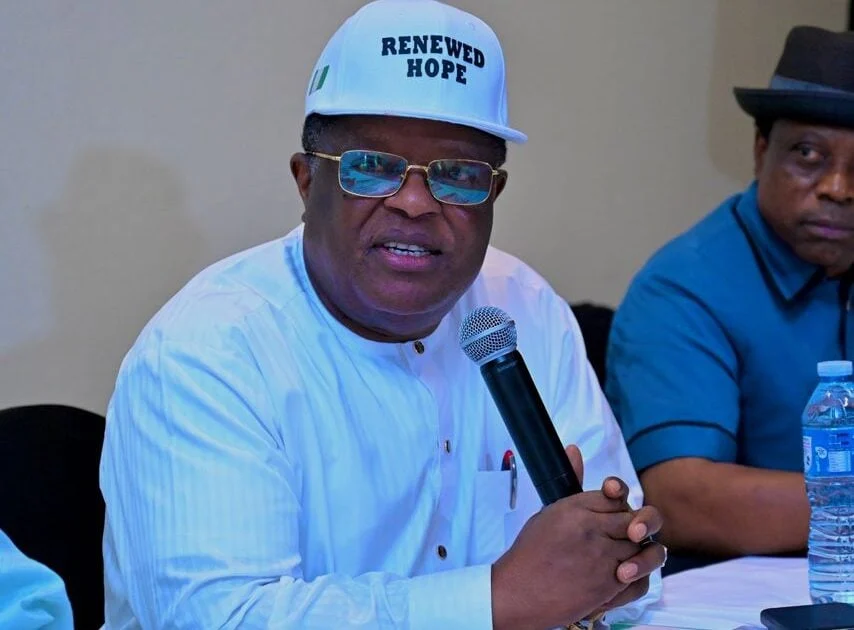
Minister of Works David Umahi Inaugurates Strategic Committee to Oversee Logistics for the 2026 All Progressives Congress National Convention
The Minister of Works, Senator David Umahi, formally inaugurated the Accommodation and Transportation Committee on Tuesday, marking a pivotal transition in the All Progressives Congress (APC) preparations for its 2026 National Convention. Scheduled for March 27 and 28, 2026, in Abuja, the event is widely regarded as a watershed moment for Nigeria’s ruling party, necessitating meticulous planning to accommodate thousands of delegates, high-ranking government officials, and international observers. The inauguration, held at the Transcorp Hilton in Abuja, signals the party’s intent to avoid the logistical bottlenecks that have historically plagued large-scale political gatherings in the nation’s capital.
Senator Umahi, who serves as the committee’s co-chair alongside the Governor of Kano State, Abba Kabir Yusuf, emphasized that the efficacy of the convention rests on a foundation of operational excellence. With the committee tasked with managing the movement and housing of a significant portion of the Nigerian political elite, the mandate includes securing hotel capacity across the Federal Capital Territory (FCT) and streamlining transit corridors between the Nnamdi Azikiwe International Airport, designated hotels, and the primary convention venue.
A Chronology of Preparations and Strategic Intent
The road to the 2026 National Convention began with the party’s internal assessment of its administrative capacity following the 2023 general elections. Since late 2025, the APC National Working Committee (NWC) has been engaged in a series of stakeholder consultations aimed at consolidating its grassroots support and refining its internal democratic processes.
The timeline for the convention, finalized for the last week of March 2026, provides the newly inaugurated committee with roughly six months to execute its logistical blueprint. This period is considered critical, as the party intends to use this window to verify delegate lists from all 36 states and the FCT, a process that is inextricably linked to the housing and transportation planning overseen by Umahi and Governor Yusuf. By initiating this committee well in advance, the party aims to mitigate the "last-minute syndrome" that often complicates political logistics in Nigeria, where sudden influxes of thousands of visitors frequently strain local infrastructure.
The Anatomy of the Logistics Committee
The committee is structured as a dual-leadership model to ensure comprehensive oversight. Senator Umahi leads the transportation component, leveraging his ministerial oversight of federal road infrastructure to ensure that vehicular movement within the capital is optimized. Governor Abba Kabir Yusuf oversees the accommodation arm, a role that requires high-level negotiations with the hospitality sector in Abuja.
The inclusion of the Minister of Housing and Urban Development, Ahmed Dangiwa, as the committee secretary, further underscores the gravity of the task. Represented at the inauguration by Aderemi Oseni, Dangiwa highlighted that the committee’s composition—comprising governors, senators, and seasoned party administrators—is reflective of the APC’s commitment to internal order. The synergy between the Ministry of Works and the Ministry of Housing suggests a cross-departmental approach to logistical problem-solving, which could serve as a model for future national events.
Statistical Context and Logistical Challenges
Hosting a convention of this magnitude presents significant logistical challenges. With over 3,000 delegates expected to arrive from various geopolitical zones, the demand for high-end hotel rooms in Abuja is expected to peak between March 26 and March 29. Historically, major political conventions in Abuja generate a surge in demand that often leads to price volatility and a shortage of suitable, secure accommodation.
Data from the hospitality industry in the FCT suggests that the city currently boasts approximately 15,000 to 20,000 "star-rated" hotel rooms. The committee will likely need to block-book a substantial percentage of this capacity to prevent logistical fragmentation. Furthermore, the transportation plan must account for the safe, secure, and timely movement of governors and their security details, which requires a high degree of collaboration with the Federal Road Safety Corps (FRSC) and the Nigeria Police Force. The committee is expected to coordinate a fleet of shuttle services to minimize traffic congestion, which is a common grievance during major political events in the capital.
Official Perspectives on Operational Efficiency
During the inauguration, Senator Umahi provided a candid assessment of why this committee is essential. "When these logistics work smoothly, the convention proceeds seamlessly. When they fail, even the most carefully planned event can be disrupted," he stated. His remarks were echoed by the committee secretary’s representative, who noted that the perceived legitimacy of the convention is often tied to the comfort and convenience of the delegates.
If delegates feel that their needs are ignored or that the logistical process is chaotic, it can lead to frustration, which may bleed into the political floor proceedings. By prioritizing professional execution, the leadership of the APC is attempting to demonstrate a high level of organizational discipline, which is intended to serve as a message of unity and stability to the Nigerian electorate. The party’s decision to appoint a sitting Minister and a sitting Governor as co-chairs also signals that the convention is not merely a bureaucratic exercise, but a high-stakes political event requiring executive-level supervision.
Broader Implications for the APC
The 2026 National Convention is occurring at a pivotal juncture for the All Progressives Congress. Having held power since 2015, the party is looking toward future electoral cycles with a need to refresh its internal leadership and re-align its policy priorities with current national economic realities.
A successful, well-organized convention will likely be interpreted by political analysts as a sign of a cohesive party, whereas a disorganized event could be framed by opposition figures as evidence of internal friction. Beyond the logistical task, the convention will serve as a platform for:
- Policy Review: Assessing the impact of current federal policies on the grassroots level.
- Internal Democracy: Conducting elections for the National Working Committee, which will determine the party’s direction in the coming years.
- Party Cohesion: Providing a space for reconciliation between various factions and interest groups within the APC.
The committee’s work, therefore, is not merely about booking rooms and chartering buses; it is about creating an environment conducive to political negotiation. If the committee succeeds in delivering a frictionless experience, it will provide the party leadership with the necessary breathing room to focus on the political agenda rather than firefighting logistical crises.
Expected Outcomes and Future Steps
As the committee transitions from the inauguration phase to the implementation phase, the public can expect a series of announcements regarding designated transportation hubs and accommodation guidelines. The committee will likely engage with the Abuja Environmental Protection Board (AEPB) and local security agencies to ensure that the event adheres to city regulations.
Furthermore, the integration of technology in managing delegate movements—such as digital accreditation and real-time transit tracking—is being explored as a means to increase efficiency. If the committee can integrate these digital solutions, it would mark a significant modernization of political event management in Nigeria.
The minister’s closing statement, in which he called for divine guidance and professional dedication, reflects the somber responsibility placed upon these leaders. With the eyes of the nation turned toward Abuja in March 2026, the success of the Accommodation and Transportation Committee will be the first metric by which the public judges the party’s readiness for the next phase of its governance trajectory. As preparations continue, the committee’s ability to remain disciplined and proactive will be the definitive factor in ensuring that the 2026 APC National Convention is remembered for its political impact rather than its logistical challenges.

Related Posts
Lagos State Government Issues Urgent Flood Warning as 2026 Rainy Season Forecast Projects Intense Precipitation
Mediterranean Shipping Company signs 45-year agreement with Nigerdock to develop Snake Island Container Terminal